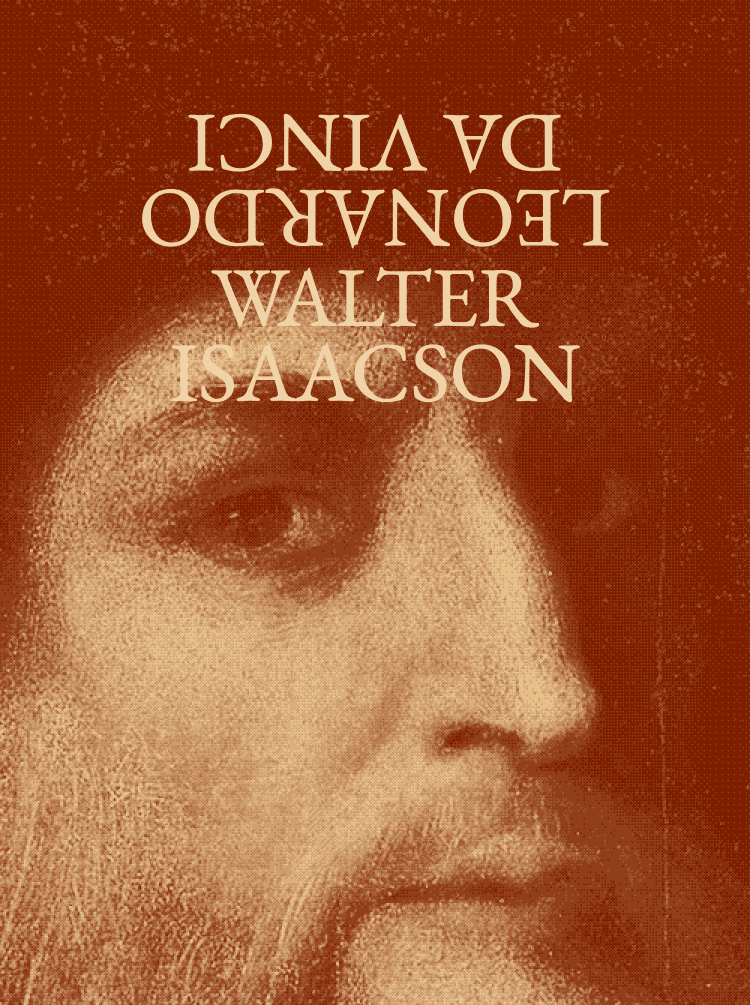
What happens when relentless curiosity meets talent, observation, and imagination? You get Leonardo da Vinci—the man who, five centuries ago, sketched ideas for helicopters, parachutes, diving suits, and even an odometer. If his notebooks had been shared in his own time, some believe we might’ve landed on the moon by the 1800s.
Walter Isaacson’s biography Leonardo da Vinci gives us an up-close look at this “universal man”—an artist, engineer, scientist, and philosopher all in one.
Here are some of the most fascinating lessons and facts from the book:
The Self-Made Polymath
Leonardo was ahead of his time in ways that are still hard to believe.
- He designed flying machines centuries before the Wright brothers.
- He dreamed up tanks and air compressors long before modern warfare.
- He studied the human heart in such detail that scientists confirmed some of his findings only recently.
He wasn’t formally educated. People called him “Uomo Senza Lettere”—a man without letters—but he proudly replied: “My knowledge comes from experience.” Leonardo believed in learning by doing, drawing, dissecting, and asking endless questions.
The Person Behind the Genius
Leonardo wasn’t just a genius—he was human, full of contradictions and quirks:
- He was born out of wedlock.
- He was likely gay and openly lived outside societal norms.
- He was a vegetarian (unusual for his time).
- He was left-handed and loved playing pranks.
- He struggled to finish commissions and wasn’t great with money.
- He had a playful spirit but was serious about observing the world in every detail.
How He Learned: Curiosity First
Leonardo’s greatest talent wasn’t just painting—it was asking better questions. His to-do lists included things like:
- Measure the city of Milan.
- Learn how to walk on ice in Flanders.
- Study how birds fly.
- Understand how the heart’s valves work.
- Learn to build hydraulic structures.
His motto could have been: “Observe everything. Learn for the joy of learning.”
He believed that “God is in the details” and saw no boundary between art and science.
Artist and Engineer, All at Once
Leonardo painted with the same mindset he used for engineering.
- In The Last Supper, he chose to paint with oil on dry plaster—a mistake that caused it to deteriorate quickly, but it allowed for delicate details.
- In the Mona Lisa, he layered 18 coats of oil to create his famous “sfumato” effect, where edges disappear into soft shadows. Her smile changes depending on where you look—that’s not magic, it’s technique.
He also proposed bold engineering ideas:
- A 280-meter bridge for the Sultan of Istanbul, tested centuries later by MIT and proven feasible.
- Parachutes and war machines long before they existed in reality.
- Tools to help build the Duomo of Florence, working with techniques pioneered by Brunelleschi.
The Truth Behind the Myths
Was Leonardo hiding secrets in his art? Well, yes—but not the kind you see in conspiracy theories. He added extra meanings through symbolism, a common practice in Renaissance art. It’s not mystery—it’s semiotics.
He wasn’t an atheist, though he did paint religious figures as ordinary humans. In The Last Supper, Judas holds a bag of coins and there are no halos around the disciples. His art was about realism, not divinity.
As for the “missing years” from 1476 to 1478, historians still debate what he was doing. But the idea of him as a solitary, misunderstood genius is partly a myth. He worked with teams and collaborated frequently.
Learning from Leonardo Today
Leonardo’s life isn’t just about genius—it’s about how to think. Here are some lessons that still hold up:
- Be endlessly curious.
- Work for the joy of discovery, not just for patrons.
- Procrastinate—but in productive ways. He often let ideas “marinate” before completing them.
- Take notes! His notebooks are some of the most valuable treasures of the Renaissance.
- Collaborate. Even Leonardo didn’t work alone.
His philosophy was simple but profound:
“A day well spent brings happy sleep. A life well spent brings a happy death.” And also: “Those who think little, make many mistakes.”
Leonardo da Vinci wasn’t a man who lived in the past—he was a blueprint for the future. Isaacson’s book reminds us that the best kind of genius isn’t about being the smartest person in the room. It’s about staying curious, asking questions, and never losing the wonder of discovery.
