
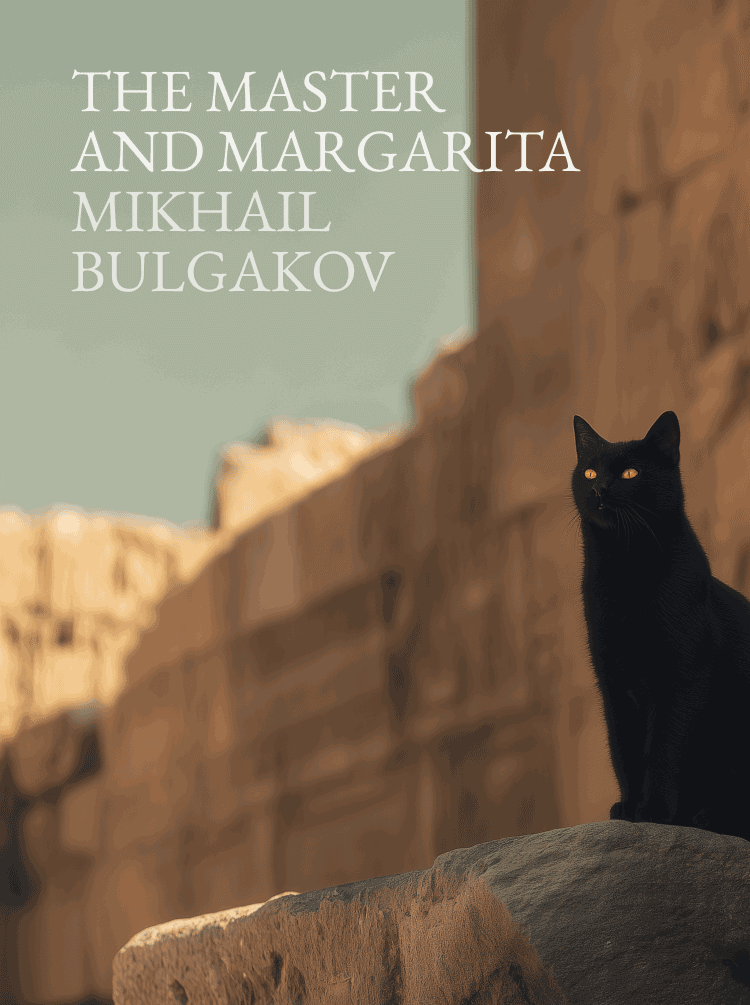
What would happen if, one day, the devil decided to gather his entourage and take a stroll through Moscow? How would such a figure be received in a society obsessed with materialism and denial of the metaphysical? More importantly—how would he see us?
That’s the premise behind The Master and Margarita, by Mikhail Bulgakov, the first Russian novel I’ve had the pleasure of reading.
No spoilers here, only love ✨
Set in the Soviet Union of the 1920s and 30s, the novel unfolds in layers. On one side, we follow the Master, an author who dares to write a masterpiece about Pontius Pilate and pays the price for it. Attacked by the literary critics aligned with the regime, he is driven to despair, burns his manuscript, and commits himself to a psychiatric clinic.
Meanwhile, the devil, appearing as a gentleman named Woland, arrives in Moscow with his infernal troupe. They wander through the city, exposing the absurdities and hypocrisies of Soviet life, while searching for a woman to serve as queen at their midnight ball—a ritual they seem to repeat across ages and places.
Between the grotesque and the comic, Bulgakov weaves these two narrative threads: the satire of bureaucratic oppression and blind materialism, and the philosophical reflection on truth, cowardice, and justice through the Master’s retelling of Pilate’s inner conflict as he condemns an innocent man for the sake of political order.
Bulgakov’s target is clear: he ridicules the authoritarian leadership of Stalin’s era and the sycophantic literary circles that persecuted him throughout his life. Yet, amid this sharp critique, the novel never loses its fantastical, almost carnivalesque spirit—mixing elements of Goethe’s Faust, magical realism, and a kind of artistic resistance that refuses to bow to oppression.
One message stands out above all: that true art can’t be silenced. And even if the artist does not earn eternal glory, at the very least, they deserve peace.
